Tretinoin Strength, Fine Lines, and Irritation: What 48 Weeks Actually Measured
A comparison of 0.1% and 0.025% tretinoin found similar observed facial improvement but more irritation at the higher strength. Its striking tissue percentages describe microscopy—not percent wrinkle reduction.
Public-source editorial review. No clinician sign-off, firsthand testing, patient-image assessment or individual prescription advice claimed.
A tretinoin percentage identifies a concentration, not a promised degree of wrinkle improvement. That distinction is especially important in a 1995 study comparing two topical creams over 48 weeks. Both concentrations improved clinical photoaging relative to vehicle, while the higher concentration caused more redness and scaling. Under the microscope, both also produced substantial changes—but those changes were not measurements of how much younger a face looked.
For fine-line evidence, the useful question is how clinical appearance, tissue measurements, and tolerability fit together. This analysis uses the indexed primary report abstracts for the 1995 comparison, a two-year tretinoin trial, and a separate retinol study, alongside available official RENOVA labeling. It does not assume access to complete study protocols or supplements. Together, these records support a more precise reading than either stronger-is-better marketing or a blanket claim that concentrations are interchangeable.
Within this reading
Study facts at a glance
Study population: The 1995 report describes 99 completers over 48 weeks: 32 using 0.1% tretinoin, 35 using 0.025%, and 32 using vehicle. Source 1
Appearance versus irritation: Both concentrations improved facial photoaging relative to vehicle; observed efficacy was similar, while redness and scaling were greater with 0.1%. Source 1
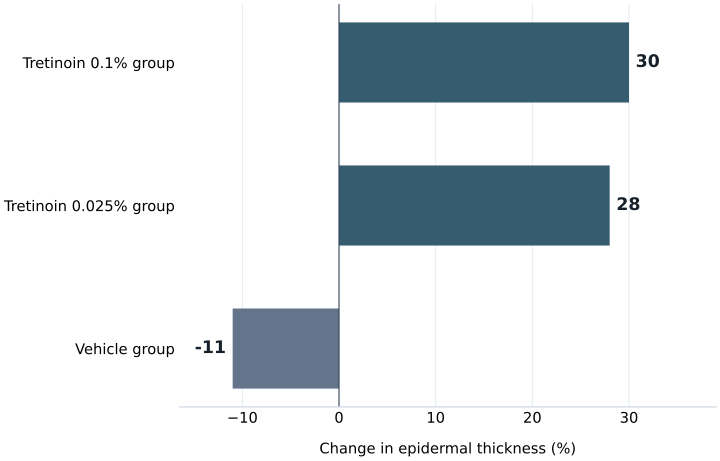
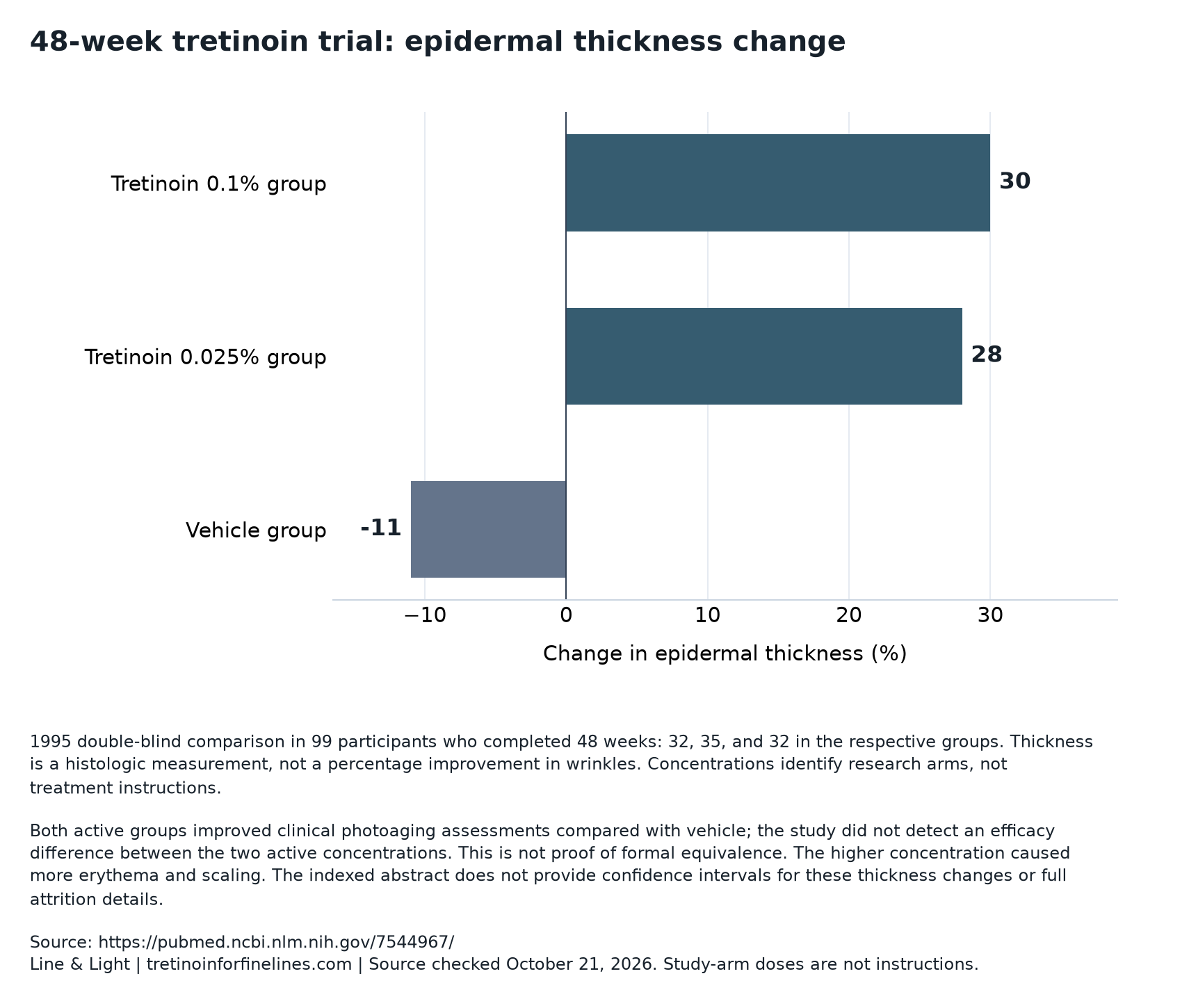
Microscopy is not wrinkle reduction: Epidermal thickness increased 30% and 28% in the active groups, and vascularity increased 100% and 89%. These were tissue measures, not cosmetic response percentages. Source 1
Longer follow-up: A separate 204-subject study followed facial treatment with 0.05% tretinoin emollient cream or vehicle for up to two years; its abstract reports improvements without numerical clinical effect sizes. Source 2
Product-specific labeling: RENOVA 0.02% has a limited adjunctive indication for mitigating fine facial wrinkles with comprehensive skin care and sunlight avoidance, not a universal anti-aging approval. Source 3
The comparison involved three creams and 99 completers
The 1995 double-blind, vehicle-controlled study examined people with photoaged skin—skin showing changes associated with chronic sunlight exposure. Participants used topical 0.1% tretinoin cream, 0.025% tretinoin cream, or vehicle once daily over 48 weeks. Vehicle means the cream base without the active drug. These concentrations and frequency identify historical study exposures; they are not instructions for individual treatment.
The abstract says that 99 patients completed the study, with 32, 35, and 32 in the respective groups. It does not establish that 99 were initially randomized or enrolled. Without that starting denominator, withdrawal counts, or reasons for leaving, readers cannot calculate retention or determine whether intolerance affected completion differently between groups.
Double blinding was intended to reduce expectation-related differences in assessment. However, more visible irritation in one group could potentially make treatment assignment easier to guess; the abstract does not report whether blinding remained successful. It also does not give detailed demographic distributions, baseline severity by group, or sponsorship information. Those missing details limit appraisal without erasing the reported comparison.
The historical 48-week comparison: clinical and tissue outcomes are different kinds of evidence.
| Study arm | Completers and exposure | Reported findings at 48 weeks |
|---|---|---|
| Tretinoin 0.1% | 32; topical cream once daily | Clinical improvement versus vehicle; epidermal thickness +30%; vascularity +100%; greater irritation than 0.025% |
| Tretinoin 0.025% | 35; topical cream once daily | Similar observed clinical improvement to 0.1%; epidermal thickness +28%; vascularity +89% |
| Vehicle | 32; cream base once daily | Epidermal thickness −11%; vascularity −9%; comparator for active treatment |
Read the underlying chart data: download CSV or download the source-labeled chart.
Similar observed improvement is not proof of equivalence
Both tretinoin concentrations produced statistically significant overall improvement in facial photoaging compared with vehicle. The investigators reported no clinically or statistically significant efficacy difference between the active concentrations. That supports a specific conclusion: in this study, the higher concentration did not show a detectable additional clinical advantage at the reported assessment.
It does not establish formal equivalence or noninferiority. Those designs ask whether a difference lies within a predefined acceptable margin and require suitable statistical planning. The indexed abstract supplies neither such a margin nor a confidence interval around the between-concentration difference. A nonsignificant difference alone cannot exclude every potentially meaningful difference.
The abstract also does not identify a single prespecified primary endpoint or provide the numerical clinical scale results. Consequently, the report cannot tell readers how many fine-line score units separated treatment and vehicle, or what proportion achieved a particular cosmetic threshold. Our guide to fine lines versus deeper wrinkles explains why a broad photoaging result should not be silently narrowed into a precise fine-line claim.
A 30% thicker epidermis does not mean 30% fewer wrinkles
Histology examines tissue structure under a microscope. After 48 weeks, epidermal thickness increased by 30% with 0.1% tretinoin and 28% with 0.025%, while the vehicle group showed an 11% decrease. The epidermis is the skin’s outer cellular layer. These relative changes describe that measured structure, not wrinkle depth, facial appearance, or the percentage of participants who improved.
An illustrative calculation makes the distinction concrete. If an imagined baseline thickness were 100 measurement units, a 30% increase would make it 130 units. That example explains the arithmetic only; it is not an actual study measurement. Nothing in the calculation determines whether a wrinkle score fell by one point or whether a person noticed a difference.
Subtracting the reported changes gives a 41-percentage-point contrast between the 0.1% arm and vehicle, and a 39-percentage-point contrast for 0.025%. Those are contrasts between relative tissue changes, not estimates of 41% or 39% wrinkle improvement. Without absolute thicknesses, variability, and paired clinical data, the cosmetic meaning cannot be reconstructed from these percentages.
The vascularity result measured endothelial area
The vascularity finding is especially easy to overread because one reported increase reached 100%. Investigators measured dermal endothelial cell area: an assessment involving the cells lining blood vessels in the dermis. Vascularity increased by 100% with 0.1% tretinoin and 89% with 0.025%, compared with a 9% decrease with vehicle.
A 100% increase means the measured quantity doubled relative to its baseline. It does not mean complete restoration of skin, a doubling of cosmetic benefit, or that every participant experienced the same change. Nor does a tissue-area measurement directly establish greater blood flow or a clinically desirable change in visible facial vessels.
The study’s simultaneous appearance and microscopy findings show that treatment affected more than one outcome domain. They do not provide a validated equation translating vascularity into wrinkle improvement. Similarly, fine-line photographs document surface appearance under particular conditions; they cannot establish the cellular changes measured in a biopsy.
Irritation separated from the measured benefit
Redness, termed erythema, and scaling were statistically significantly greater with 0.1% than with 0.025% tretinoin across the reported analyses. The abstract does not supply event percentages, severity distributions, or confidence intervals, so the absolute increase in irritation cannot be calculated. Still, the direction of the tolerability difference is clear.
This creates the study’s most useful scientific separation: substantially different irritation accompanied similar observed clinical and histologic outcomes. The investigators interpreted that pattern as suggesting that mechanisms other than irritation dominate tretinoin-associated improvement. In plain language, more visible inflammation did not function as a reliable marker of more benefit in this comparison.
That interpretation is narrower than proving irritation never contributes or that improvement always occurs without it. Establishing mediation—whether one process causes another—would require evidence beyond parallel group outcomes. The study also found no significant treatment-versus-vehicle changes in the assessed immune markers, including selected cellular markers and immune-cell counts. Those negative findings do not prove that all immune activity was unchanged or irrelevant.
The two-year trial answers a different duration question
A 2005 randomized, placebo-controlled report evaluated 0.05% tretinoin emollient cream in 204 subjects with moderate to severe facial photodamage. Treatment or vehicle emollient cream was applied to the entire face once daily for up to two years. Scheduled visits assessed clinical and histologic effects. This extended the follow-up window but did not repeat the 0.1%-versus-0.025% comparison.
The abstract reports greater improvement with tretinoin in fine and coarse wrinkling, mottled hyperpigmentation, lentigines, sallowness, overall photodamage severity, and the investigator’s global response assessment. It gives no numerical endpoint changes or confidence intervals. Statistical significance therefore establishes a reported treatment difference, not its visible magnitude or the chance that a particular user would notice it.
Histology showed no increase relative to vehicle in keratinocytic or melanocytic atypia, dermal elastosis, or adverse stratum-corneum changes. At three centers, a procollagen synthesis marker increased at month 12. Procollagen is a collagen precursor, not a direct measure of wrinkle removal. These findings do not establish cancer prevention, survival benefit, or lifetime safety; the abstract also lacks detailed adverse-event rates and sponsor information.
RENOVA’s label has a narrower product-specific boundary
Official labeling for RENOVA 0.02% concerns a specific topical oil-in-water formulation. Its indication is adjunctive mitigation of fine facial wrinkles in patients using comprehensive skin care and sunlight avoidance. It does not establish elimination of wrinkles, restoration of younger skin, or efficacy for every feature of photodamage. The RENOVA label guide separates that indication from broader promotional language.
The label describes five controlled 24-week trials involving 324 evaluable active-treatment patients and 332 vehicle patients. Ratings used a 10-unit scale, with changes grouped into categories. Two trials adequately demonstrated fine-wrinkle efficacy. For coarse wrinkling, mottled hyperpigmentation, tactile roughness, and laxity, no two of the five trials adequately demonstrated efficacy. Vehicle participants also received the skin-care and sunlight-avoidance program, making that background care part of the comparison.
These are not the creams or trial populations of the 1995 concentration study. The label identifies Bausch Health US LLC as the packager and distributor, which does not establish sponsorship of the historical research. Its product-specific limits also remain distinct from the two-year 0.05% report: evidence for one formulation and duration does not automatically extend the labeled evidence for another.
How RENOVA 0.02% trial ratings categorized change from baseline—not percent wrinkle removal.
| Label category | Change on the rating scale | Interpretation |
|---|---|---|
| No improvement | No change | The rating did not move from baseline |
| Minimal improvement | Reduction of 1 unit | One scale-unit change, not a specified percentage of wrinkle reduction |
| Mild improvement | Reduction of 2 units | A larger rating change, not a direct measurement of wrinkle depth |
| Moderate improvement | Reduction of 3 units or more | A grouped threshold that can include different-sized changes |
| Worsening | Increase of 1 unit or more | A higher severity rating than baseline |
Lower concentration does not mean irritation-free
RENOVA’s safety results provide quantitative context, but they must not be substituted for missing adverse-event rates in the 1995 trial. Among 339 patients applying RENOVA 0.02% in double-blind studies, almost all reported at least one local reaction, such as peeling, dryness, burning, stinging, redness, or itching. About 4% discontinued because of adverse reactions.
The label reports that 32% experienced irritation that was severe, prompted temporary discontinuation, or led to mild topical corticosteroid use. This is a combined category, not a statement that 32% had severe irritation alone. About 7% of active-treatment patients, compared with less than 1% of controls, required short-term mild topical corticosteroids for sufficiently severe irritation.
Other labeled concerns include heightened sunburn susceptibility, photosensitizing drug interactions, and pregnancy restrictions. The label states that RENOVA 0.02% should not be used during pregnancy or while attempting pregnancy. These boundaries explain why tolerability and medical screening matter even when the goal is cosmetic. The sun-protection evidence guide also explains why background protection cannot be separated casually from facial-wrinkle trial results.
The retinol arm study offers scores, not a strength ranking
The 2007 retinol study involved 36 elderly adults, averaging 87 years of age, living in two senior facilities. In a randomized, double-blind, within-person comparison, study staff applied 0.4% retinol lotion or vehicle to opposite arms up to three times weekly for 24 weeks. Ingredient, site, aging context, and exposure schedule all differed from the facial tretinoin studies.
On a 0-to-9 fine-wrinkling scale, mean change was −1.64 with retinol, with a 95% confidence interval of −2.06 to −1.22, versus −0.08 with vehicle, with an interval of −0.17 to 0.01. Subtracting those reported means gives a 1.56-point greater reduction with retinol. That is an arithmetic score contrast, not a 1.56% improvement or a direct estimate of wrinkle depth.
The analysis used last observation carried forward to handle missing follow-up, which assumes an earlier observation can stand in for a later one. Biochemical findings came from very small subgroups: six for glycosaminoglycan expression and four for procollagen I staining. The full explanation of the aged-skin retinol study examines these limitations. Nothing here establishes a head-to-head ranking of 0.4% retinol against either tretinoin concentration.
Matching a commercial claim to a measured endpoint
An evidence-matched claim needs to name what improved: a clinical severity rating, a response category, or a tissue measurement. It also needs a site and time window. A facial result at 48 weeks and an arm-skin result at 24 weeks cannot be treated as interchangeable simply because both concern vitamin A–related ingredients.
Editorial interpretation: concentration is a specification to inspect, not a stand-alone measure of value. The 1995 study provides no prices, contract comparisons, or evidence about commercial services. Our preparation-comparison guide organizes the documentary questions. The Dermatica review and Nurx review can be used to check published formula, fee, and renewal terms—not to infer that either service reproduces these study conditions or outcomes.
Important unanswered questions remain: the confidence interval around the concentration difference, outcomes among everyone initially enrolled, the timing of irritation versus benefit, and the relationship between individual biopsy changes and visible response. Results also do not transfer automatically to compounded combinations, oral routes, other formulations, or providers. Answering those questions requires directly matched evidence rather than a shared ingredient name.
Questions about the evidence
Did the 48-week study prove that 0.025% works exactly as well as 0.1%?
No. It reported similar observed clinical improvement and no clinically or statistically significant efficacy difference. The abstract does not provide a formal equivalence margin or a confidence interval for that difference. It supports the absence of a demonstrated higher-strength advantage in this comparison, not exact interchangeability for every patient or formulation.
Does peeling show that tretinoin is working better?
Not in this comparison. The higher concentration produced more redness and scaling without a corresponding detected increase in clinical benefit. That weakens the idea that visible irritation is a useful benefit gauge. It does not prove irritation has no biological role under any circumstances.
Why are the large microscopy percentages less informative about appearance?
They measure different quantities. Epidermal thickness and endothelial cell area can change substantially without specifying a change in fine-line score or wrinkle depth. The study would need linked clinical and tissue data to estimate how those measurements relate within individuals; the abstract does not supply that relationship.
Does the two-year study override RENOVA 0.02% labeling limits?
No. The two-year report studied a 0.05% emollient cream, while the label concerns RENOVA 0.02%. Different formulations, populations, and study designs cannot be collapsed into a single approval claim. The label states that daily RENOVA 0.02% safety and effectiveness beyond 52 weeks have not been established.
Can collagen-related findings establish skin-cancer prevention or resistance to injury?
No. Procollagen staining is a biological marker, not a clinical cancer or injury outcome. The retinol study’s abstract discusses possible resistance to injury, but its reported outcomes do not establish fewer ulcers. RENOVA labeling likewise states that prevention or treatment of actinic keratoses or skin neoplasms has not been established.
What this evidence supports
The strongest reading of the 48-week comparison is a separation between observed benefit and irritation: both tretinoin concentrations improved facial photoaging relative to vehicle, while 0.1% caused more redness and scaling without a demonstrated additional clinical advantage. The tissue findings reinforce that treatment changed skin biology, but their percentages cannot be relabeled as wrinkle reduction. Longer-term tretinoin evidence and the separate retinol trial add useful context without resolving concentration equivalence or predicting individual response. For fine-line claims, the defensible unit of evidence remains the measured endpoint in its actual population, formulation, site, and follow-up period—not the concentration printed most prominently.
Research access and limitations
Research appraisal here is based on indexed original-study abstracts and full official RENOVA labeling. Missing clinical effect sizes, concentration-comparison confidence intervals, enrollment and attrition details, and detailed historical adverse-event data prevent a complete assessment of precision and bias. Historical trial reports are not current prescribing instructions.
The records behind this article
- Two concentrations of topical tretinoin (retinoic acid) cause similar improvement of photoaging but different degrees of irritation. A double-blind, vehicle-controlled comparison of 0.1% and 0.025% tretinoin creams. ↗Indexed original research abstract · Accessed 2026-10-21
- Long-term efficacy and safety of tretinoin emollient cream 0.05% in the treatment of photodamaged facial skin: a two-year, randomized, placebo-controlled trial. ↗Indexed original research abstract · Accessed 2026-10-21
- RENOVA tretinoin cream 0.02% prescribing information ↗FDA labeling via DailyMed; record updated February 24, 2026; internal revision November 2025 · Accessed 2026-10-21
- Improvement of naturally aged skin with vitamin A (retinol). ↗Indexed original research abstract · Accessed 2026-10-21